
Can you pour concrete in the winter in New York? This is one of the most common questions property owners ask when cold weather sets in, and construction projects are still on the schedule. With freezing temperatures, snow, and constant freeze-thaw cycles, winter concrete work in New York requires far more planning than a typical warm-weather pour.
While concrete can be poured during winter months, it must be done correctly to avoid cracking, surface damage, and long-term structural issues. Temperature control, proper curing methods, and experienced handling all play a critical role in whether winter concrete succeeds or fails. For homeowners and businesses across New York, understanding these factors is essential before moving forward with any cold-weather concrete project.
Can You Pour Concrete in Winter?
Yes, you can pour concrete in the winter. Concrete can be poured during winter months if temperature control, mix design, and curing protection are handled correctly. According to the American Concrete Institute (ACI) 306, concrete placement is allowed when air temperatures are below 40°F (4°C), as long as the concrete temperature stays above freezing during early curing.
Concrete does not stop working in winter. The hydration process continues at low temperatures, but at a slower rate. Problems start when concrete freezes before reaching enough compressive strength, usually 500 psi (3.5 MPa). Winter concrete pouring succeeds when contractors control concrete winter temperature, prevent ice formation, and protect the slab after placement.
How New York Winter Temperatures Affect Concrete?
New York winters create some of the most challenging conditions for concrete work. Temperatures often fluctuate above and below freezing within a single day, which directly impacts how concrete sets and gains strength. These sudden changes can cause fresh concrete to lose heat too quickly, slowing the hydration process that gives concrete its durability.
Snow, ice, and cold winds also increase moisture exposure on job sites. When concrete is poured onto frozen ground or exposed to freezing air too soon, it can develop weak spots, surface scaling, or internal cracking. In urban areas of New York, wind tunnels between buildings can further accelerate heat loss, making temperature control even more critical during winter pours.
What Is the Minimum Temperature to Pour Concrete in New York?
Temperature plays a critical role in whether concrete can be safely poured during a New York winter. Fresh concrete should generally be placed when air and ground temperatures are at least 40°F and expected to remain above freezing for the first 24 to 48 hours. This initial period is when concrete is most vulnerable to damage from cold weather.
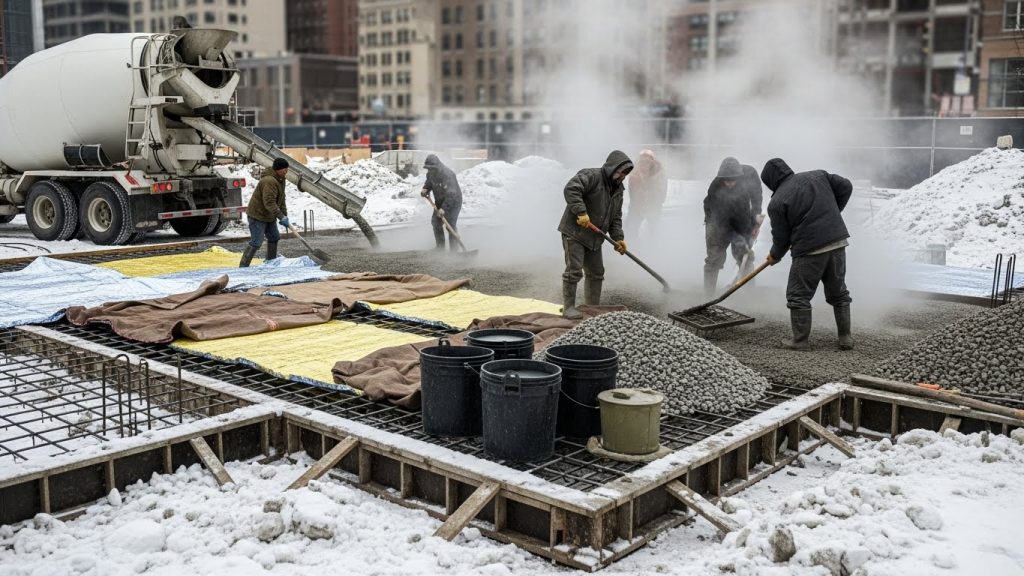
If temperatures drop below 32°F before the concrete gains enough strength, the water inside the mix can freeze and expand. This weakens the internal structure and can lead to cracking, scaling, and reduced durability. In New York, where overnight temperatures often fall sharply, contractors must plan pours carefully and use protective measures to keep concrete warm until it cures properly.
6 Tips for Pouring Concrete in Cold Weather
1. Picking the Best Concrete for Cold Weather
Cold weather concrete needs a winter concrete mix designed for early strength. Type III Cement develops strength faster than standard mixes. Air-Entrained Concrete improves resistance to freeze-thaw cycles by creating space for water expansion. A lower water-cement ratio reduces excess moisture that can freeze.
Early Strength Concrete works best for sidewalks, slabs, and foundations poured in winter.
2. Prepare Site and Materials Before Pouring the Concrete
Subgrade preparation controls most winter concrete problems. Remove snow, ice, and frozen soil before placement. Use ground thawing equipment to raise ground temperature above 32°F (0°C). Frozen aggregate or icy formwork lowers concrete temperature on contact.
Formwork insulation and windbreaks reduce heat loss during placement. Pre-pour site prep prevents frozen ground challenges and slab cracking.
3. Carefully Monitor Temperature of Concrete
Temperature monitoring is required for winter concrete care. Fresh concrete should enter the forms between 50–70°F (10–21°C). Maintain curing temperature above 40°F (4°C) for at least 48 hours.
Use thermocouples, infrared thermometers, or the Concrete Maturity Method to track internal concrete temperature. Concrete heaters and heated enclosures help maintain optimal winter conditions.
4. Accelerating Admixtures Increase Set Times for Concrete
Accelerating admixtures speed up hydration and reduce setting time in cold weather. Calcium Chloride is a common accelerator allowed by the Portland Cement Association (PCA) within dosage limits. Non-chloride accelerating admixtures are used when corrosion risk exists.
Accelerated curing agents help concrete reach early strength before freezing temperatures occur.
5. Adding More Cement Increases Hydration
Increasing cement content raises heat generation during hydration. More cement improves winter strength development and reduces hydration retardation risks. Heated concrete mix water also increases initial concrete temperature.
Avoid excess water. A high water-cement ratio increases freezing risk and surface scaling during thawing cycle impact.
6. Worker Safety When Pouring Concrete in Cold Weather
Worker safety affects project quality. Cold stress, icy surfaces, and limited daylight increase risk. Heated shelters, proper gloves, and slip-resistant footwear protect crews. Safe working conditions allow better placement, finishing, and curing control.
Common Problems With Winter Concrete Pouring in New York
There are 6 common winter concrete problems in New York:
- Premature freezing caused by low curing temperature
- Winter concrete cracks from freeze-thaw cycles
- Surface scaling due to excess water and poor air entrainment
- Reduced compressive strength from hydration interruption
- Frozen subgrade settlement after thawing
- Delayed set times from improper winter mix adjustments
Most winter concrete problems come from poor temperature control and lack of insulation.
How Professionals Pour Concrete Safely in New York Winters
Experienced concrete contractors in New York use specific methods to ensure concrete sets and cures properly during winter. Cold-weather concrete mixes are specially formulated to generate heat and resist freezing. Heated water and warm aggregates are often used in the mix to maintain the ideal temperature for hydration.
Before pouring, snow, ice, and frost must be removed from the ground to prevent weak spots. Insulating blankets or thermal covers help retain heat after the pour, and temporary enclosures or heaters can create a controlled environment for larger projects.
Non-chloride accelerators may also be added to speed up the curing process without causing corrosion. Hiring a professional ensures that all these steps are followed correctly to protect the quality and durability of the concrete.
FAQs – Pouring Concrete in Winter in New York
Can you pour concrete in freezing weather in winter?
Yes. Pour concrete below freezing, if concrete temperature stays above 32°F (0°C) during early curing.
What is the coldest you can pour concrete in the winter?
Concrete placement is allowed at air temperatures below 32°F (0°C), if heated concrete, insulation, and monitoring are used.
Can you pour a concrete driveway in the winter?
Yes. Driveways need air-entrained concrete, insulated concrete blankets, and extended curing time.
Can you pour concrete foundations in winter?
Yes. Foundations often use heated enclosures, ground thaw prevention, and early strength concrete.
What happens if concrete freezes before curing?
Concrete loses compressive strength, develops internal cracks, and fails durability standards.
Final Verdict: Is It Safe to Pour Concrete in a New York Winter?
Yes, it is safe to pour concrete in a New York winter. Winter concrete pouring works when contractors follow ACI 306 guidelines, control temperature, protect against freezing, and use proper winter concrete mix designs. Cold weather concreting requires planning, insulation, heating, and monitoring, but it delivers durable slabs, foundations, and sidewalks even during harsh winter conditions.