
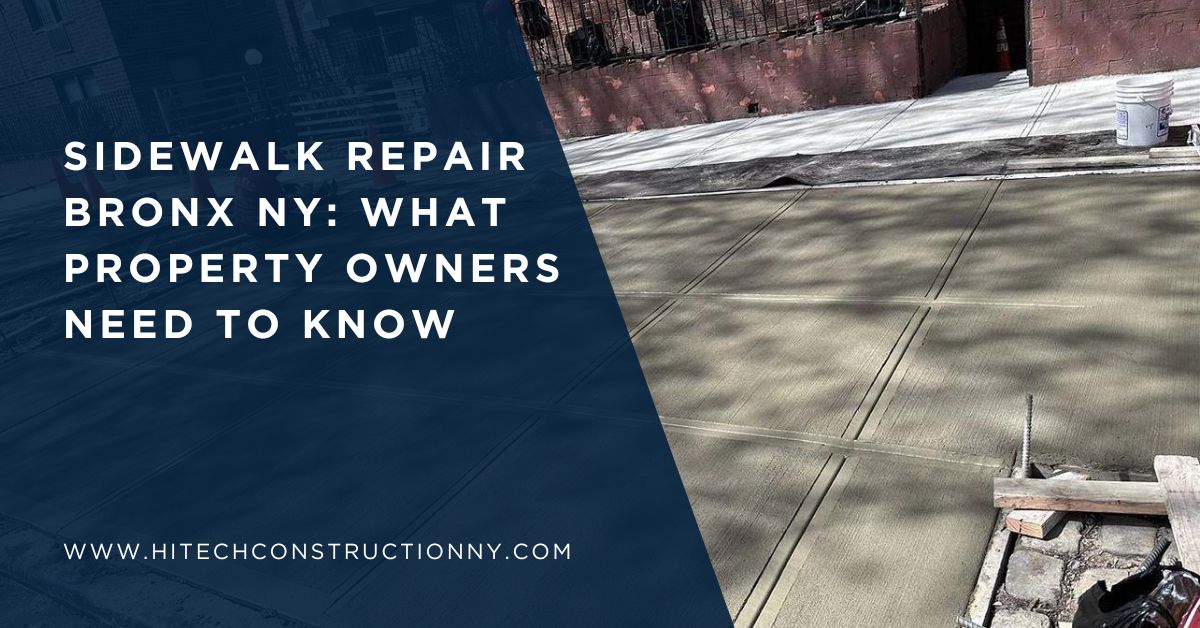
If you own property in the Bronx, the sidewalk in front of your building is your problem. Not the city’s. Not your tenant’s. Yours. Under NYC Administrative Code Section 7-210, every property owner in the Bronx is legally required to maintain, repair, and keep the adjacent sidewalk safe for pedestrians. When the concrete cracks, shifts, or creates a trip hazard, the DOT violation lands on the property owner. So does the personal injury lawsuit if someone goes down.
Sidewalk repair in the Bronx carries the same legal weight as in any other borough, but the Bronx has its own set of conditions that make sidewalk deterioration faster and more common. Older concrete infrastructure, dense mature street trees, harsh winters, and heavy commercial vehicle traffic all compound each other. The result is that Bronx property owners deal with DOT violations and damaged sidewalks at a higher rate than many other parts of the city.
This guide covers everything you need to know: what causes Bronx sidewalks to fail, what repairs cost, how the permit process works, and how to choose a contractor who actually closes your violation from start to finish.
Who Is Responsible for Sidewalk Repair in the Bronx?
The answer is straightforward. The property owner is responsible. Section 7-210 of the NYC Administrative Code applies to every borough including the Bronx, and it places full maintenance and repair responsibility on whoever holds the deed. It does not matter whether a tenant occupies the building, whether the damage was caused by a city tree, or whether the sidewalk has been in poor condition since before you purchased the property. When DOT issues a violation, it goes to the owner of record.
If your property sits on a corner, you are responsible for both frontages. That means two separate DOT permit applications and potentially two separate repair projects if both sides have been flagged. This catches many Bronx property owners off guard when they receive violation notices for both street-facing sidewalks at the same time.
Tenants are not off the hook in every case. If a commercial lease places sidewalk maintenance responsibility on the tenant, a property owner may have a contractual basis to recover repair costs from the tenant after completing the work. But DOT does not recognize lease terms. The repair obligation stays with the owner, and it must be completed before any cost recovery can be pursued.
If a city-owned tree caused the damage, owners of one to three-family homes may qualify for the NYC Parks Department Trees and Sidewalks Program, which covers repair costs at no charge. Commercial properties and larger residential buildings do not qualify. In all cases, the repair must be completed first. You cannot wait for the city to act and then submit the claim.
Why Bronx Sidewalks Deteriorate Faster
The Bronx has conditions that accelerate sidewalk deterioration more than most parts of New York City.
The borough has one of the densest urban tree canopies in the five boroughs. Streets like Pelham Parkway, Riverdale Avenue, the Grand Concourse, and large sections of the North Bronx are lined with mature trees whose root systems extend aggressively beneath sidewalk slabs. These roots follow the path of least resistance, growing under joint gaps and slab edges until they lift the concrete from below. What starts as a quarter-inch displacement becomes a full violation within one or two growing seasons.
Bronx winters hit concrete hard. Water seeps through existing cracks and joint gaps, freezes during cold snaps, expands, and forces those cracks wider from the inside. After enough cycles, a surface crack becomes a through-crack, and a through-crack becomes a slab that needs to come out entirely. Concrete that was installed with a weaker mix or thinner pour, common in older Bronx residential neighborhoods, deteriorates noticeably faster under this pressure.
Commercial corridors in the Bronx add another variable. Areas like Fordham Road, Hunts Point, Port Morris, and Mott Haven see consistent heavy truck traffic. Delivery vehicles and commercial equipment crossing residential sidewalks designed for foot traffic only compress the sub-base, crack slabs, and create raised edges over time. Once the sub-base is compromised, even newly poured concrete will sink or shift within a few years if the underlying problem is not addressed first.
Common Sidewalk Problems We Fix in the Bronx
Raised and uneven slab edges are the most frequent cause of DOT violations across the Bronx. When one panel sits higher than the adjacent one, the resulting lip becomes a trip hazard. DOT flags any vertical displacement over half an inch. At 1.5 inches or more, the situation qualifies for immediate attention and often emergency response.
Surface cracks from freeze-thaw damage are extremely common in older Bronx concrete. Hairline cracks that were manageable two winters ago become structural fractures that require full slab replacement if left unaddressed. Patching cracks at the surface level without addressing the underlying cause is a short-term fix that will fail the DOT dismissal inspection.
Sunken and settled slabs appear frequently in areas where tree roots have disturbed the soil beneath the panels. The slab itself may still be intact, but if it has dropped below the surrounding grade, it creates pooling water, a trip hazard, and a drainage problem that directs water toward the building foundation. Fixing a sunken slab requires removing the panel, regrading the sub-base, and pouring new concrete at the correct elevation.
Spalling and surface deterioration on older Bronx sidewalks is widespread. Deicing salt, foot traffic, and years of freeze-thaw cycles break down the concrete surface layer and expose the aggregate beneath. Moderate spalling can be addressed with resurfacing overlays. Severe spalling requires full slab removal and replacement.
Bronx Sidewalk Repair Services
Hi Tech Construction NY provides a full range of sidewalk repair services in NYC for residential and commercial properties throughout the Bronx. Every project starts with a free on-site inspection and a written estimate issued within 24 hours. We handle the permit, the repair, and the DOT dismissal inspection. Property owners do not need to manage any part of the process themselves.
Our Bronx sidewalk repair services cover concrete crack patching and surface repair for minor damage, full slab replacement for panels that are beyond grinding or patching, trip hazard grinding and leveling for raised edges under 1.5 inches, sidewalk violation removal from permit filing through dismissal inspection, emergency sidewalk repair for hazardous conditions that cannot wait on a standard permit timeline, ADA curb ramp installation and upgrade for corner properties, and curb and gutter repair for sections where the curb structure has deteriorated alongside the sidewalk.
For commercial properties on Fordham Road, the Grand Concourse, and other high-traffic Bronx corridors, we pour commercial-grade 7-inch slabs designed to handle the structural load of heavy foot traffic and adjacent vehicle use. Standard residential pours at 4-inch thickness will not hold up under commercial conditions, and using the wrong specification leads to repeat violations within a few years.
DOT Sidewalk Violations in the Bronx
DOT identifies sidewalk violations in the Bronx through routine borough inspections, complaints submitted through 311, and flags raised after pedestrian injury reports. Once a violation is issued, the property owner has 75 days to complete the repair and schedule a dismissal inspection. The initial violation carries a $150 fine. Missing the 75-day deadline escalates the penalty to $250 to $300. If the property owner continues to ignore the violation, DOT contracts the repair using its own contractors and bills the owner through the property tax account at rates that run two to three times above market price.
An open violation also creates ongoing personal injury liability. If someone trips on your flagged sidewalk while the violation is unresolved, you are exposed to a lawsuit with documented city evidence that you knew about the hazard and did not act. That combination of an open violation and a personal injury claim is the most expensive outcome possible and is entirely avoidable with a timely repair.
Closing a Bronx sidewalk violation requires four steps: hiring a licensed contractor registered with NYC DOT, filing the permit before work begins, completing the repair to DOT specifications, and scheduling and passing the dismissal inspection. The violation is not closed until the inspector signs off. A physically complete repair that skipped the permit step does not close the violation.
If you want to understand the full liability picture before starting the repair process, our breakdown of who is responsible for sidewalk repair in NYC walks through ownership obligations, tenant scenarios, and tree root situations in detail.
The Permit Process for Bronx Sidewalk Repair
Every sidewalk repair project in the Bronx requires a DOT permit before work begins. No exceptions apply for repair size or urgency. Starting work without an active permit triggers a stop-work order, additional fines, and leaves the original violation open on DOT records even after the concrete is poured.
The permit application requires the contractor’s NYC DOT registration number, proof of general liability insurance and workers’ compensation coverage, property ownership documentation, and a work scope description including square footage. The permit fee is $70 for up to 300 linear feet. Corner Bronx properties with work on both frontages pay this fee twice.
Standard permit approval takes two to three weeks from a complete submission. Hi Tech Construction NY prepares and submits the full permit package within 48 hours of project approval. We have filed over 800 DOT permits with a 100% first-attempt approval record. Incomplete applications are returned by DOT and restart the clock, which is how most delays happen when property owners use contractors who do not handle the permit process properly.
For the full permit walkthrough including every form and fee, read our guide on how to apply for a sidewalk repair permit in NYC.
How to Choose the Right Sidewalk Repair Contractor in the Bronx
The contractor you hire determines whether your DOT violation actually closes. Many contractors in the Bronx complete the physical repair but leave the permit filing and DOT inspection scheduling entirely to the property owner. That creates a situation where the concrete looks fine, but the violation remains open because the permit and dismissal inspection steps never happened.
Before signing anything, verify that the contractor holds a current NYC DOT registration and carries both general liability insurance and workers’ compensation coverage. Ask for insurance certificates directly. Verbal confirmation is not sufficient. Ask explicitly whether the contractor files the DOT permit, manages the inspection, and provides final documentation. If the answer is unclear, find another contractor.
Get a written, itemized estimate before work begins. A legitimate contractor separates labor, materials, demolition, disposal, permit fees, and any tree root or ADA ramp costs on paper. A lump-sum quote with no breakdown makes it impossible to understand what is included or to compare proposals accurately. Confirm that the work comes with a written warranty. If something fails after completion, a verbal promise is unenforceable.
Red flags worth walking away from: quotes significantly lower than all other estimates with no explanation, contractors who do not mention permits, crews that want to start work immediately without a filed permit, and anyone who cannot produce an insurance certificate on request.
Conclusion
Bronx sidewalk damage does not stay the same. A tree root lifts a panel by half an inch this season and 1.5 inches by next spring. A surface crack left through two winters becomes a structural fracture. A DOT violation ignored past 75 days becomes a city-contracted repair billed at three times the cost. Every stage of that progression is more expensive than acting on it earlier.
Hi Tech Construction NY has been completing licensed sidewalk repair projects across the Bronx and all five NYC boroughs since 2001. We handle the inspection, permit, repair, and DOT sign-off under one contract with a written warranty on every project. Call (718) 600-4676 for a free on-site inspection and a written estimate within 24 hours.