
If you’re standing in your driveway right now staring at cracks, sunken pavers, or a slab that’s heaving on one side, you already know NYC weather doesn’t play fair with driveways. Between the freeze thaw cycles every winter, road salt, and decades old soil under most boroughs, picking the wrong material can mean redoing the job in half the time you expected.
Quick Answer: Concrete driveways typically last 25 to 30 years in NYC with proper installation, while paver driveways can last 25 to 50 years since individual pavers can be replaced without redoing the whole surface. Concrete handles heavy vehicle weight better as one solid slab, but pavers resist cracking from freeze thaw cycles because the joints between them flex instead of breaking. The better long term choice depends on your soil, drainage, and how much upkeep you’re willing to do.
This guide breaks down how each material actually performs once winter hits Queens, Brooklyn, Staten Island, or anywhere else in the five boroughs, not just how they look on installation day.
Why NYC Weather Is Brutal on Driveways
Before getting into which material wins, it helps to understand what they’re up against. NYC sees roughly 20 to 30 freeze thaw cycles every winter. Water gets into tiny cracks or joints, freezes, expands, and pushes the surface apart. This happens over and over from December through March.
Add in the rock salt most homeowners and the city use to melt ice, and you’ve got a second problem. Salt accelerates the breakdown of concrete by attacking the surface and causing it to flake or spall. It’s less damaging to pavers since the individual units aren’t as chemically reactive to deicing salts, though the joint sand between them can still wash out over time.
Then there’s the soil itself. A lot of NYC properties sit on clay heavy or poorly draining ground, especially in older neighborhoods. Without proper grading and a solid base, both concrete and pavers will eventually shift no matter which one you pick.
Neighborhoods built on fill, which describes a good chunk of Brooklyn, Queens, and parts of Staten Island, tend to see more settling over time than areas sitting on bedrock like much of Manhattan and the Bronx. If your home is in one of those fill heavy areas, base preparation matters even more than usual, since the ground underneath is doing more moving year to year.
How Concrete Driveways Hold Up in NYC
Concrete is poured as one continuous slab, which gives it real strength for handling cars, SUVs, and delivery trucks parked in the same spot day after day. When it’s mixed and poured correctly, with the right depth and reinforcement, a concrete driveway can realistically last 25 to 30 years before it needs replacement.
The catch is that concrete cracks. Not always right away, but eventually, especially once freeze thaw cycles get into any hairline crack that forms early on. Once water gets behind that crack and freezes, it widens fast. You’ll usually see this happen near the edges of the driveway first, or wherever a tree root has pushed up from underneath.
Repairs on concrete are also less forgiving. You can’t just swap out one damaged section without it looking patched, since matching old concrete color and texture to new pours is tricky. Most contractors will recommend resurfacing or replacing larger sections once cracking spreads, which adds up in cost over the life of the driveway.
If you’re already dealing with concrete cracking on your property, the repair approach matters a lot, and the same principles that apply to repairing a cracked sidewalk in NYC apply to driveway slabs too.
One thing a lot of homeowners don’t expect is how much faster concrete damage shows up on a driveway with a slight slope toward the street, which is common on a lot of NYC properties built for drainage. Water that doesn’t fully run off pools in low spots, sits there through a freeze, and widens whatever crack happens to be nearby. A flat or poorly graded driveway is more prone to this than one with a proper pitch built in from the start.
Concrete Pros for NYC Homeowners
- Lower upfront cost per square foot
- Handles consistent heavy vehicle weight well
- Smooth surface, easier snow removal with a plow or shovel
- Fewer weeds and less joint maintenance
Concrete Cons for NYC Homeowners
- Cracks once water and freeze cycles get into weak spots
- Patch repairs are visible and rarely match the original
- Salt damage shows up as surface flaking over time
- Full replacement is the usual fix once damage spreads
How Paver Driveways Hold Up in NYC
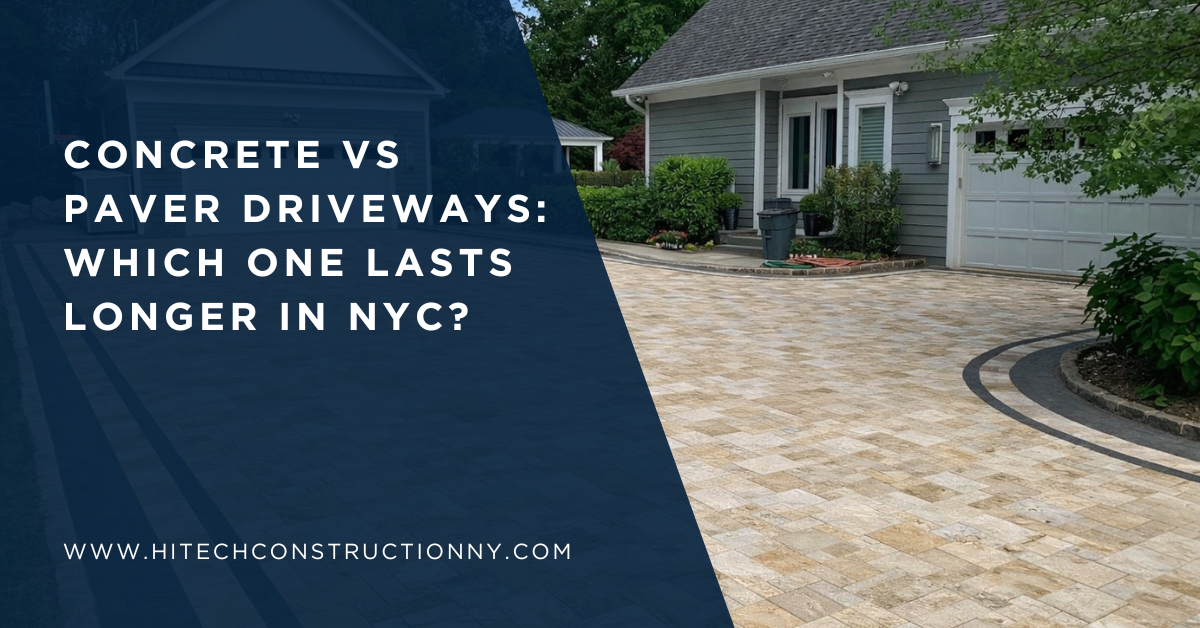
Pavers are individual interlocking stones or concrete units set on a compacted base with sand filled joints. Because the surface is made of separate pieces instead of one slab, it has more give. When the ground shifts slightly from frost heave, pavers can move with it instead of cracking outright.
This is the real advantage in a city with this much freeze thaw activity. A concrete slab has nowhere to go when the ground underneath swells, so it cracks. Pavers absorb that movement at the joints. Some homeowners do notice individual pavers becoming uneven over a few winters, but that’s a far easier fix than a cracked slab.
Repairs are also more practical with pavers. If one section gets damaged, a contractor can lift those specific units, regrade the base if needed, and reset them without touching the rest of the driveway. That’s a meaningful cost difference over a 20 or 30 year span compared to concrete, where damage usually means a bigger patch or full resurfacing.
The tradeoff is maintenance. Joint sand washes out over time and needs to be replenished every few years, weeds can grow between pavers if joints aren’t sealed properly, and the upfront installation cost runs higher than concrete because of the labor involved in laying each unit individually.
Most paver driveways in NYC need joint sand topped off every 3 to 5 years, and a fresh seal coat every 4 to 6 years depending on how much sun and salt exposure the surface gets. Skipping this for too long is usually what leads to the shifting and unevenness people associate with poorly aging paver driveways, when in reality the material itself wasn’t the problem.
Paver Pros for NYC Homeowners
- Flexes with ground movement instead of cracking
- Damaged sections can be repaired individually
- More design options for color, pattern, and border
- Often outlasts concrete with proper joint maintenance, sometimes 40 to 50 years
Paver Cons for NYC Homeowners
- Higher installation cost upfront
- Joint sand and weed maintenance needed periodically
- Individual pavers can shift or sink if the base wasn’t compacted properly
- Snow removal can be trickier around edges and borders
Concrete vs Pavers: Side by Side for NYC Conditions
| Factor | Concrete | Pavers |
|---|---|---|
| Average lifespan | 25 to 30 years | 25 to 50 years |
| Upfront cost | Lower | Higher |
| Freeze thaw resistance | Cracks under repeated cycles | Flexes, resists cracking |
| Salt resistance | Can flake or spall over time | More resistant, joint sand may wash out |
| Repair method | Patch or resurface | Lift and reset individual units |
| Maintenance | Low, occasional sealing | Moderate, joint sand and weed control |
| Best for | Budget conscious, heavy daily vehicle use | Long term value, design flexibility |
Which One Actually Lasts Longer
If you’re going purely by raw lifespan numbers, pavers tend to win in NYC because of how well they handle freeze thaw movement and because individual units can be replaced instead of the whole surface. A well installed paver driveway with consistent joint maintenance can outlast a concrete driveway by a decade or more.
That said, concrete isn’t a bad choice, and for a lot of homeowners it’s the more practical one. If your driveway sees constant heavy vehicle traffic, like multiple cars or a regularly used delivery truck, a well poured concrete slab handles that load more predictably than pavers, which can shift under repeated heavy weight if the base wasn’t properly compacted.
The honest answer is that lifespan depends less on the material itself and more on installation quality. A poorly installed paver driveway with a thin base will fail faster than a well poured concrete slab, and a poorly poured concrete slab without proper reinforcement will crack faster than properly set pavers. This is the same lesson that applies across the sidewalk repair process in NYC, where the base preparation matters more than the surface material on top of it.
What Actually Determines How Long Your Driveway Lasts
A few things matter more than the material choice itself once you’re deciding between concrete and pavers.
Base preparation. Both materials need a properly compacted gravel base, usually 4 to 8 inches depending on soil conditions. Skipping this step is the single biggest reason driveways fail early in NYC, regardless of what’s on top.
Drainage. Water needs somewhere to go. A driveway that pools water near the foundation or along the edges will deteriorate faster no matter the material, since standing water makes freeze thaw damage worse.
Reinforcement for concrete. Rebar or wire mesh inside the slab helps it resist cracking under weight and frost movement. Skipping reinforcement to save money upfront is one of the most common mistakes on NYC driveway pours.
Joint maintenance for pavers. Letting joint sand wash away without replacing it lets pavers shift more than they should, which speeds up wear.
Sealing. Both materials benefit from periodic sealing, which helps block water and salt from getting into the surface in the first place.
Cost Considerations Over Time
Pavers cost more to install but tend to need less invasive repairs later on. Concrete costs less upfront but the repairs, when they’re needed, are usually bigger jobs since you can’t isolate small sections as easily.
If you’re trying to plan ahead for either option, the same budgeting logic used for sidewalk repair costs in New York applies to driveways. Factor in not just the install cost but what a realistic repair every 10 to 15 years will run you, and the long term math often evens out between the two materials.
To put rough numbers on it, a standard concrete driveway in NYC typically runs somewhere in the range of 8 to 14 dollars per square foot installed, depending on thickness, reinforcement, and site access. Pavers usually land closer to 15 to 25 dollars per square foot once you account for the base work and labor of setting individual units. On a typical two car driveway, that gap can mean a few thousand dollars difference upfront.
Where the math shifts is in year 15 or 20. A concrete driveway that’s cracked badly by then often needs a full tear out and repour, which can cost close to the original installation price again. A paver driveway at that same age, assuming reasonable joint maintenance along the way, usually only needs a partial reset of a few sections, which costs a fraction of a full replacement. Over a 30 year span, the totals tend to land closer together than the initial price tags suggest.
When Driveway Damage Becomes Urgent
Cracks and shifting pavers don’t always need to be fixed immediately, but there are situations where waiting makes things worse. A crack that’s letting water pool and refreeze every winter will spread faster each season. A sunken section near the curb cut can create a tripping hazard or block proper drainage toward the street.
If you’re dealing with a driveway issue that’s gotten worse quickly, especially after a hard freeze or heavy rain, it’s worth treating it the same way you’d treat an emergency sidewalk repair in NYC, where addressing the damage early prevents a small fix from turning into a full replacement.
Driveway Violations and DOT Rules
Most homeowners think of violations as a sidewalk issue, but driveway aprons and the section connecting to the curb can fall under similar scrutiny if they’re cracked, uneven, or causing drainage problems onto city property. It’s worth understanding how NYC DOT rules apply to sidewalk and apron repair before starting any driveway work that touches the curb line, since permits and inspection rules can apply depending on the scope of the job.
If you’ve already received a notice, the process for removing a sidewalk violation in NYC follows similar steps even when the issue originates from the driveway apron rather than the main sidewalk slab. And if you’re unsure whether what you’re looking at even qualifies, it helps to first understand what counts as a sidewalk violation in NYC before assuming the worst.
Repair or Replace: How to Decide
Sometimes the question isn’t concrete versus pavers, it’s whether to repair what you already have or start over. A few isolated cracks in concrete or a handful of shifted pavers usually point to repair. Widespread cracking, multiple sunken sections, or a base that’s clearly failed across the whole driveway point to replacement.
This decision tree is basically the same one used for sidewalk repair versus replacement in NYC, and it applies just as well to driveways. The general rule is that if more than 30 percent of the surface is damaged, replacement usually ends up cheaper than chasing repairs section by section.
Frequently Asked Questions
Do pavers crack like concrete does in NYC winters?
Not in the same way. Since pavers are individual units, freeze thaw movement tends to shift or unlevel them rather than crack them outright. Concrete cracks because it’s one solid piece with nowhere to absorb that movement.
Is it cheaper to repair pavers or concrete long term?
Pavers usually cost less to repair over time since damaged sections can be lifted and reset individually. Concrete repairs typically involve patching or resurfacing larger areas, which adds up across a couple of decades.
Can I install pavers over an existing concrete driveway?
Generally no, not without proper base work underneath. Pavers need a compacted gravel base and sand bedding layer to perform correctly. Laying them directly over concrete skips the part that gives pavers their flexibility advantage in the first place.
Which option adds more resale value in NYC?
Pavers tend to add slightly more curb appeal value due to the design options, though this varies by neighborhood and what’s typical for similar homes nearby. Concrete still holds solid value as the more expected, lower maintenance option.
Making the Right Call for Your Property
There’s no universal answer to whether concrete or pavers last longer, because it depends on your soil, how the base was prepared, how much traffic the driveway sees, and how consistent you are with maintenance. Pavers generally edge out concrete on raw lifespan thanks to how they handle freeze thaw movement, but concrete remains the more budget friendly option for heavy, consistent vehicle use.
What matters most is working with a contractor who understands how NYC soil and weather behave differently than the rest of the country. A driveway built without that in mind, regardless of material, will struggle within a few winters.
At Hi Tech Construction NY, we’ve seen both materials hold up well and fail early, and almost always the difference comes down to base prep, drainage, and proper installation rather than the material itself.
If your current driveway is already showing cracks, sunken sections, or drainage problems, our team at Hi Tech Construction NY handles driveway repair services across NYC and can walk you through whether a repair or full replacement makes more sense for your property. And if the damage extends to the sidewalk in front of your home, our sidewalk repair services in NYC cover that side of the property too, so you’re not dealing with two separate contractors for connected problems.